Pull Up Bar Finite Element Analysis
I set up and solved a finite element model of a pull-up bar with a distributed load in the middle and fixed geometries on both ends using SolidWorks Simulation. I then halved the bar and applied a symmetry fixture to produce the same results except with increased computational efficiency. Lastly, I replaced the fixed geometry on the end of the half-bar with foundation bolts and analyzed the differences in the models.
Von Misses Stress Plot (Full Bar- Fixed Geometry)

Von Misses Stress Plot (Half Bar- Fixed Geometry)

Von Misses Stress Across the Half Bar (Fixed Geometry)

Vertical Displacement (Full Bar- Fixed Geometry)
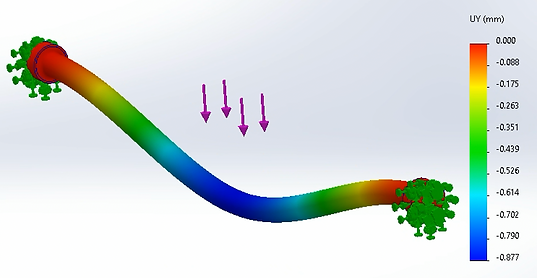
Vertical Displacement (Half Bar- Fixed Geometry)

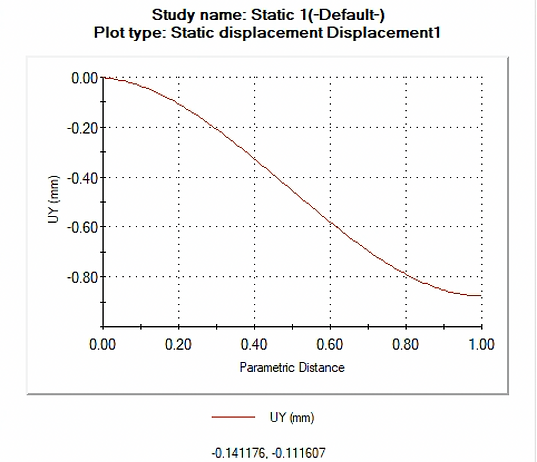
Vertical Displacement Across the Half Bar (Fixed Geometry)
Von Misses Stress Across the Half Bar (Foundation Bolts)

Von Misses Stress Across the Half Bar (Foundation Bolts)

Vertical Displacement Across the Half Bar (Foundation Bolts)

The half bar that uses the foundation bolts instead of fixed conditions experiences around 50 MPa higher peak tensile normal stress, and experiences around 50 MPa lower peak compressive normal stress.
The half bar that uses the foundation bolts also has a peak vertical displacement that is around double that of half bar with fixed conditions.